
WATERSPORT IS NOT JUST WATERSPORT
There are numerous watersports — and the requirements for a suit vary accordingly. Broadly speaking, they can be divided into two groups:
1. Watersports on the Water Surface
These include, among others: surfing, windsurfing, kitesurfing, SUP, waterskiing, kayaking, canoeing, and numerous related sports.
For these activities, a suit must fulfil different functions depending on the climate, weather conditions, and water temperature. In addition to thermal protection, flexibility, freedom of movement, UV protection, and a comfortable body climate play a crucial role.
This is because the body is working actively. When paddling, surfing, kitesurfing, or windsurfing, intensive movement generates body heat. At the same time, the athlete is exposed to wind, sun, and ambient temperature.
Therefore, simply asking “What thickness do I need?” is not really enough.
-
-
-
-
- Where do you practise your sport — in warm tropical waters, the Atlantic, the Mediterranean, or a cold Swiss lake?
- At what time of year?
- Are you a professional or a recreational athlete?
- How intensively do you move?
- Should your suit mainly protect you from wind, sun, and ambient temperature — or does it also need to keep you warm if you suddenly fall into the water?
-
-
-
This is precisely where traditional, poorly breathable rubber-based materials can become problematic: during high physical activity, heat and moisture can build up inside the suit. Within seconds, the athlete may then go from being warm and sweaty to suddenly being immersed in significantly colder water.
OUR APPROACH
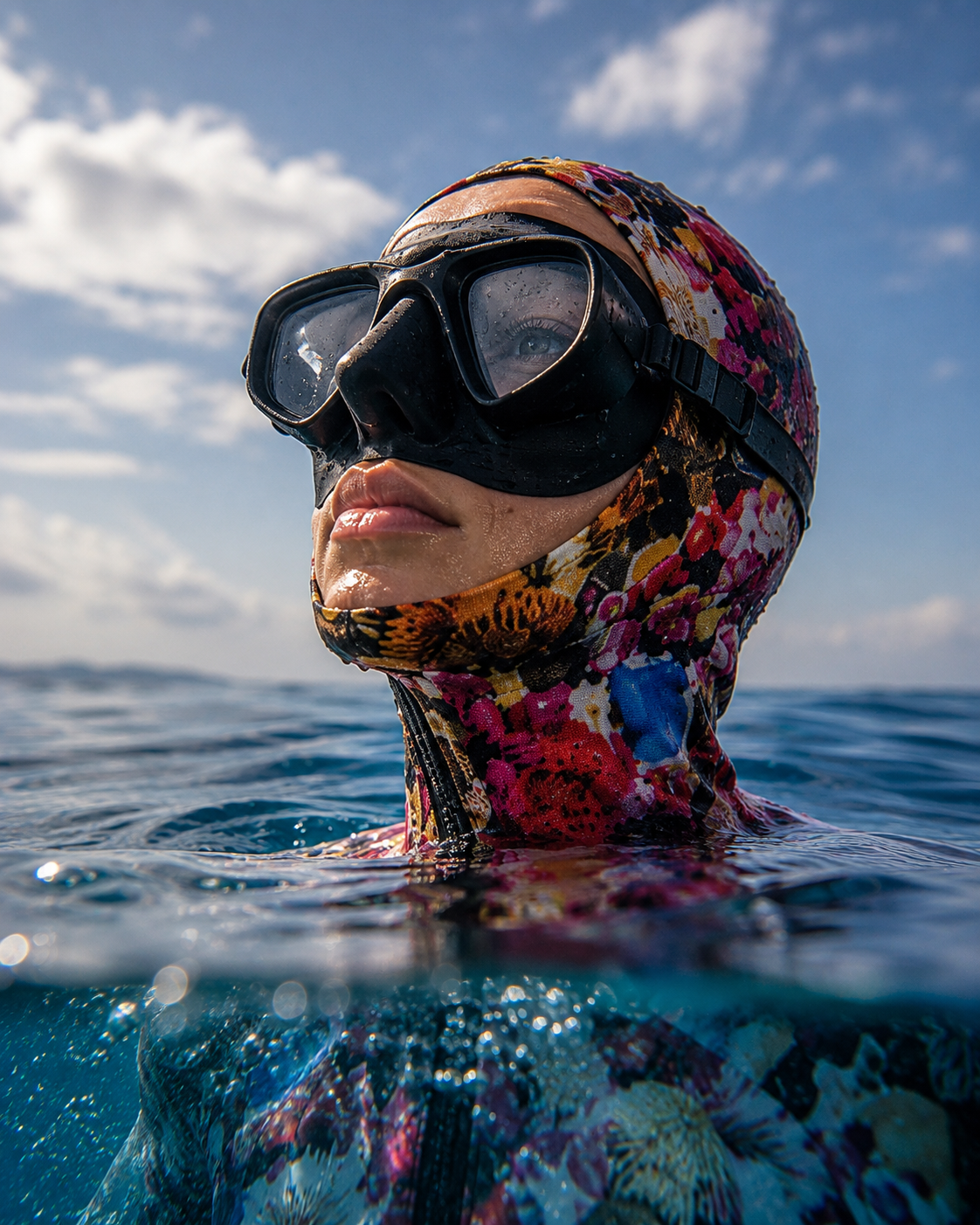
Our #neoprenefree textile watersports suits are designed to be breathable. The inner microfiber absorbs body moisture and helps transport it away from the skin. This creates a more comfortable body climate during physical activity on the water surface.
At the same time, depending on the specific construction, the materials provide thermal protection, UV protection, high flexibility, and protection against rapid cooling when coming into contact with colder water.
2. Watersports In and Under Water
These include scuba diving, freediving, underwater fishing, mermaiding, swimming, and snorkelling.
The requirements change significantly as soon as the body remains in the water for longer periods. Water draws heat away from the human body much faster than air. Thermal protection therefore becomes increasingly important. However, even within this group, there are considerable differences.
SCUBA DIVING
Divers may remain underwater for an hour or longer while moving comparatively little. Thermal insulation is therefore one of the most important requirements for a diving suit.
The lower the water temperature and the longer the dive time, the more important thermal protection becomes.
FREEDIVING
Freedivers also require thermal protection, but at the same time they need particularly high flexibility. Any unnecessary restriction of movement or breathing can be disruptive.
For this reason, many traditional freediving suits are made from very soft and delicate materials. They can be expensive while also having relatively high mechanical sensitivity.
This creates a conflict between:
Warmth — Flexibility — Durability — Comfort
A modern freediving suit should fulfil as many of these requirements as possible at the same time.
MERMAIDING
In mermaiding, freedom of movement is particularly important.
Mermaids sometimes train for extended periods in swimming pools with water temperatures of around 25°C. Although this temperature may initially feel comfortable, the body can still cool down during prolonged exposure to the water.
At the same time, large areas of the body are often only lightly thermally protected or not protected at all.
Lightweight, flexible, and visually attractive materials can offer a significant advantage here.
SWIMMING & SNORKELING
Swimmers and snorkellers often do not require very thick suits. Instead, the focus is more on light thermal protection, UV protection, freedom of movement, and comfort.
An Often-Underestimated Factor: Putting the Suit On and Taking It Off
Anyone who regularly uses traditional, tight-fitting rubber suits knows the problem.
Putting them on and taking them off can be difficult — particularly with tight, thick, or very soft suits.
Our #neoprenefree textile suits therefore take a different approach: they can be put on and taken off within seconds.
This is not only more comfortable. It can also provide a significant practical advantage, particularly for children, older watersports enthusiasts, people with limited mobility, or anyone frequently transitioning between water and land.
DESIGN IS NOT JUST ABOUT AESTHETICS —DESIGN CAN MEAN SAFETY
For a long time, the visual design of watersports suits was regarded primarily as a matter of personal taste.
In some areas, colour has already served a specific function: in underwater fishing, for example, camouflage plays an important role. In mermaiding, design is directly linked to the visual identity of the sport.
In many other watersports, however, dark or black suits still dominate today. Yet colour can fulfil another important function:
VISIBILITY.
A buddy underwater, a child by a lake, a surfer at a greater distance, or a person in poor lighting conditions can be easier to spot when their clothing clearly contrasts with the surrounding environment.
There is a reason why rescue services and many professional emergency teams use highly visible colours and visual signals.
The same principle can be applied to watersports apparel.
Especially for children, visibility in and around the water should already be taken into consideration during the design process.
A watersports suit therefore does not simply have to be black. Colour and design can create individuality.
They can make orientation easier.
They can help distinguish one person from another.
And they can contribute to visibility — and therefore to safety. The real question should therefore not be:
“How thick does my wetsuit need to be?”
But rather:
“What does my suit actually need to do for my sport, my body, and my environment?”
Warmth. Breathability. Flexibility. UV protection. Freedom of movement. Comfort. Visibility. Safety.
This is precisely where, for us, the evolution of traditional watersports apparel begins.
Not one material for every application — but materials and constructions designed around the actual requirements of each individual watersport.


